

 Deutsch
District Value and Field Info
How good a tile is, what its value is made of and what a district needs for high-rises.
With the Field Info button at the top left you can check any tile. You see how popular it is, what is going well and what is missing. The weakest value is highlighted, with a tip below.
The values of a tile
| Value | Comes from |
|---|---|
| Safety | police |
| Fire protection | fire department |
| Health | hospital |
| Education | school |
| Entertainment | cinema, park, casino, concert hall, stadium, arena |
| Traffic | roads without jams, bus stops |
| Air | little smog, parks |
| Power | power plant in range with spare capacity |
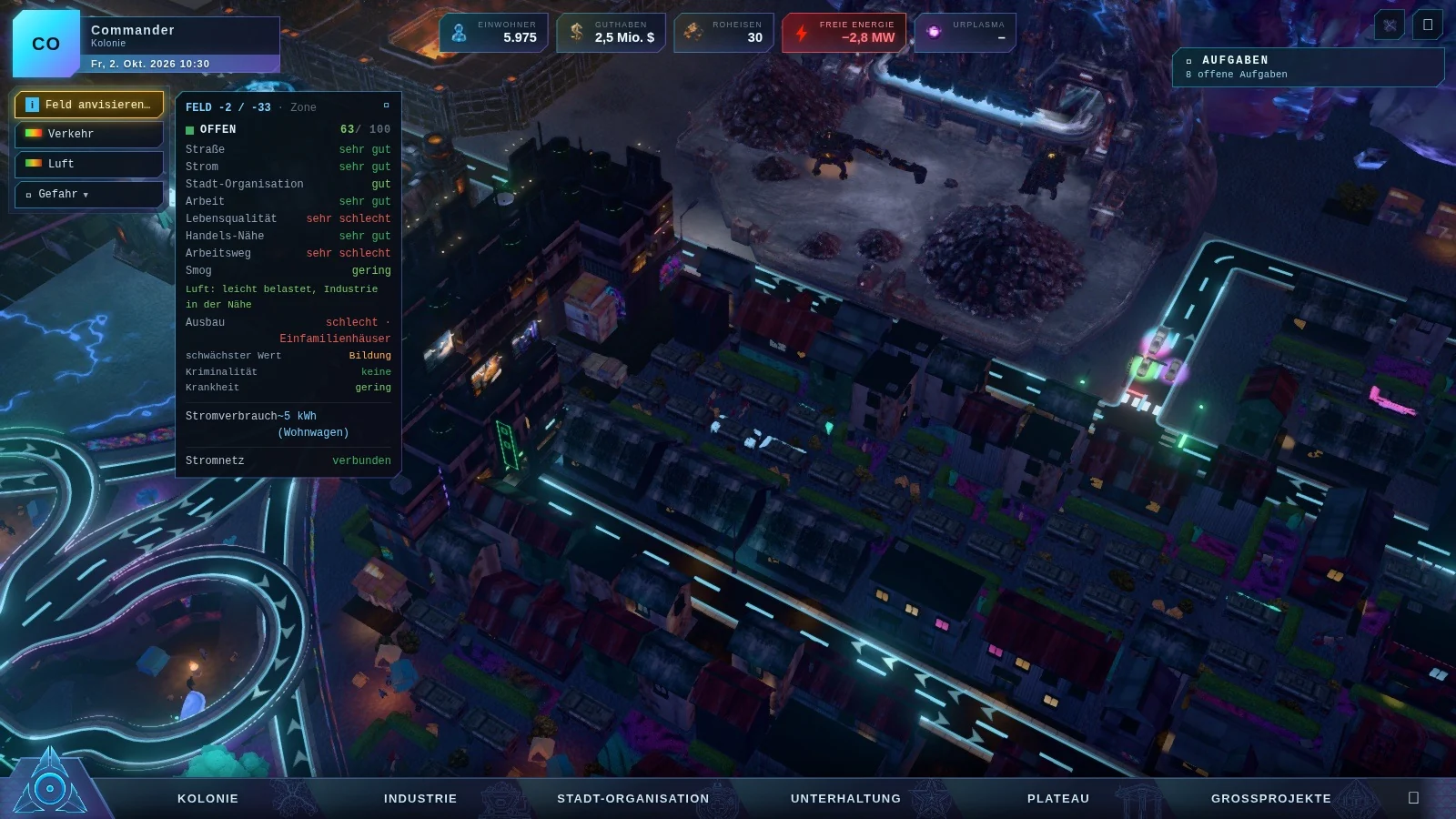
On top of that each district type has its own points: residential areas care about nearby jobs and the commute, shops about customers and competition, industry about workers and buyers.
The levels
| Level | Condition |
|---|---|
| poor | weakest value below 40 |
| fair | all values from 40 |
| good | all values from 60 |
| very good | all values from 80, entertainment from at least 3 types, bus or access tower nearby |
| excellent | all values from 90 and at least 2 active extras |
The weakest value counts. A single gap, such as missing fire protection, holds the whole tile down.
High-rises are not free
In a dense district a building only grows as tall as its level allows: from good, towers with a few floors, from very good, much taller, and the real skyscrapers only at excellent. A cinema and a bit of bus service are not enough for that.
Extras and bonuses
Extras count toward the district value too: an open park, concert hall or stadium, active overdrive protocols, VIP buildings, an access tower nearby (+15 points) or a low tax rate (Taxes).