
 Deutsch
Power and Distribution
Who gets power first, why districts are supplied all or nothing and how to spot shortages.
Next to money, power is the second big bottleneck. Without power hardly anyone moves in, no mine works and no service protects the city.
Who needs power
| Consumer | Demand |
|---|---|
| Housing | 10 kW per tile and floor |
| Trade | 2 times as much as housing |
| Industry | 5 times as much as housing, depending on the business |
| Pig iron mine at full load | 3 MW |
| Blast furnace at full load | 15 MW |
| Hospital | 3 MW |
| Police, fire station | 1 MW each |
Warehouses, access towers and most VIP buildings need no power.
The order
If power is not enough for everyone, the game distributes it in three stages:
- Services, all or nothing: hospital, fire station, police, bus stop, school, cinema, university, concert hall, casino, stadium, arena, park.
- Plants such as mines, blast furnaces and the lab all get the same share. A mine with half its power produces half its load.
- Districts, all or nothing, smallest first. A district either has power or it does not.
Consumers that can only be reached via an energy relay come after everything supplied directly.
Reach
A consumer only gets power from plants that reach it. If several plants are in range, they pool their output. Whatever lies outside every range has no grid (Power Plants).
Power reserve
New houses only appear if the power plant still has their full demand to spare. That way a whole district never goes dark when they finish. Without reserve only trailers appear.
Spotting shortages
- The Free Energy tile shows output and demand, hover for all problems.
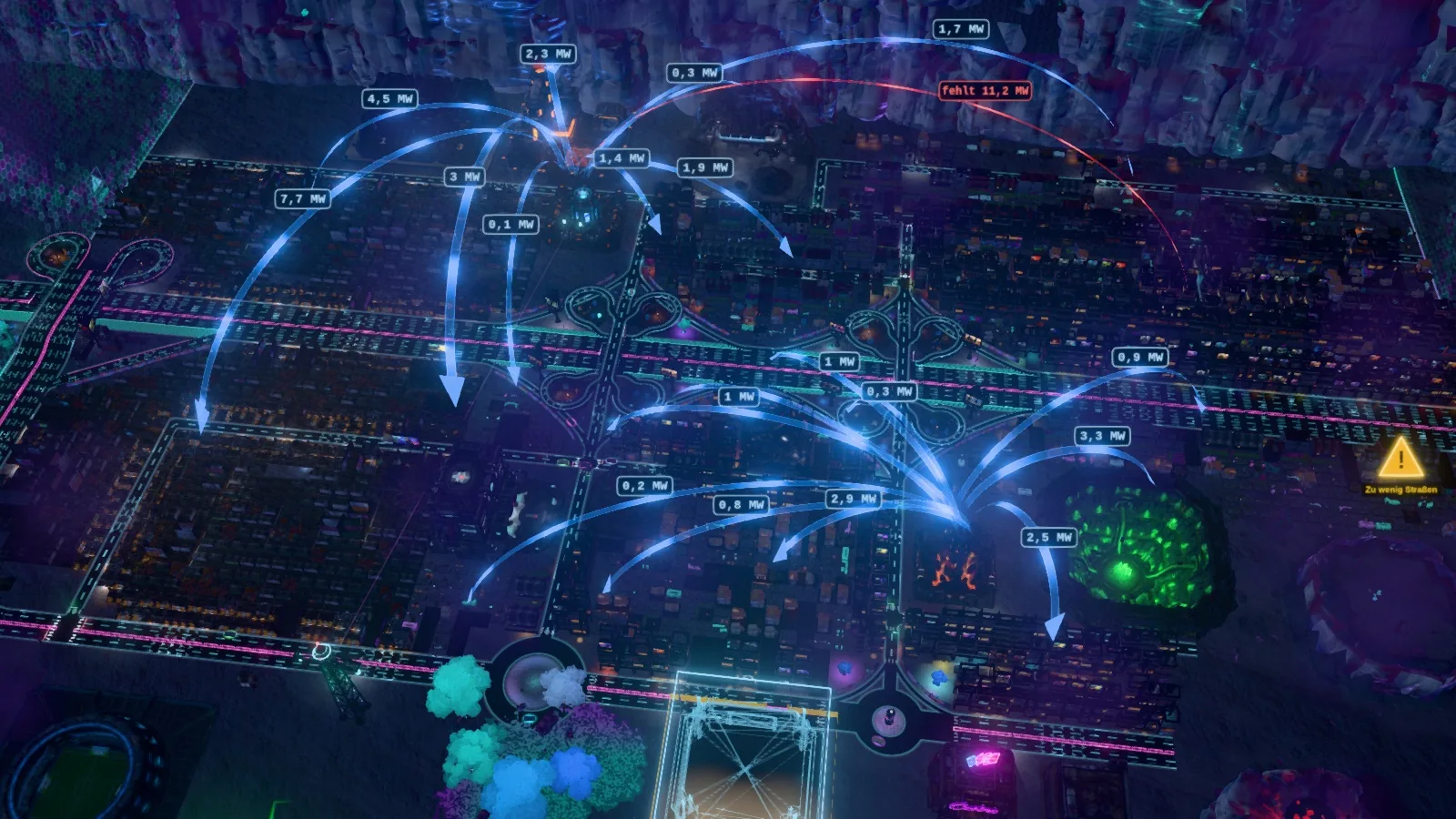
- Click a power plant: the list "Who gets what" shows services, plants and districts with their megawatts. Arrows on the map show the flow, red for "missing", orange for "partial".
- A yellow lightning sign hangs over buildings without enough power.
- In the energy menu, "Show energy flow" displays all flows in the whole city at once.